Risk engines
Stablecoins enable instant global payouts. But instant settlement introduces a liquidity problem. If a platform wants to pay out 10,000 USDC, that liquidity must exist somewhere. Traditionally, this means prefunding, so the platform deposits USDC, payouts consume the prefunded balance. This creates a hard constraint: max payout capacity equals prefunded balance. For many platforms, prefunding is inefficient or impossible. They may have incoming payments that settle in hours or days, but want to pay users immediately. Without prefunding, enabling instant payouts effectively turns the infrastructure provider into a lender. This creates credit risk.

The core engineering problem becomes: how can liquidity be allocated safely without prefunding? The answer is a real-time risk engine.
Reframing payouts as a risk allocation problem
Instead of requiring prefunding, liquidity can be allocated dynamically based on platform risk. Each payout becomes a risk decision: should liquidity be allocated for this payout? This decision must be deterministic, real-time, resistant to adversarial behavior, and continuously adaptive. This requires modeling platform reliability probabilistically.
Risk engine architecture
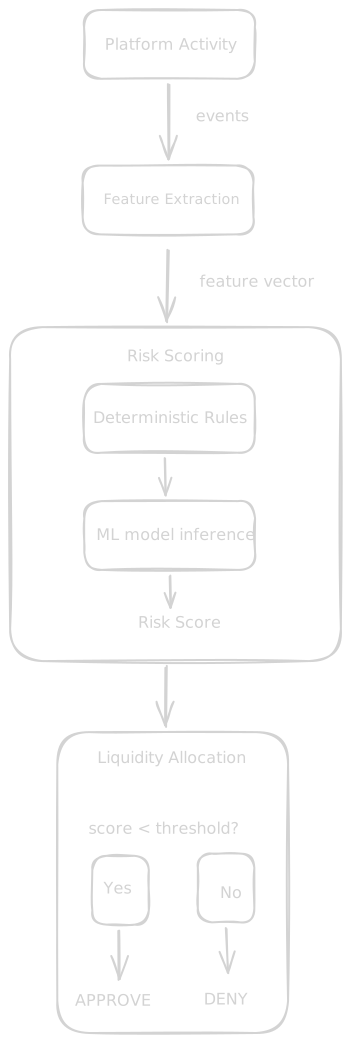
The risk engine evaluates platforms continuously using behavioral and financial signals.
Feature extraction
Risk scoring depends on high-resolution behavioral features computed incrementally across several categories. Financial velocity features capture transaction volume over sliding windows: 1-hour, 24-hour, and 7-day incoming and outgoing volume. Temporal consistency features measure stability: variance of incoming and outgoing volume, and mean interarrival time between transactions. Behavioral stability features reflect long-term reliability: account age, historical failure rate, and chargeback rate. Liquidity coverage features capture the ratio of available balance to requested payout amount. These features can be computed incrementally.
Example Postgres query:
SELECT
  SUM(amount) FILTER (WHERE created_at > now() - interval '1 hour') AS volume_1h,
  SUM(amount) FILTER (WHERE created_at > now() - interval '24 hours') AS volume_24h
FROM transactions
WHERE platform_id = $1;
Risk scoring model
Risk scoring combines deterministic rules with statistical modeling.
The base score is a weighted linear combination:
risk_score = w1 * payout_velocity_ratio
           + w2 * failure_rate
           + w3 * volatility_score
           + w4 * account_age_factor
Machine learning augmentation
Deterministic models capture known patterns. Machine learning detects the unknown ones. The ML model takes an input vector of features (payout velocity at multiple windows), payout acceleration, account age, historical failure rate, volume entropy, and time since last payout and then outputs a probability of default.
risk = model.predict(features)
if risk > 0.8:
    deny_payout()
Models would be trained on historical payout outcomes and retrained continuously as new data arrives.
Real-time inference constraints
Inference must execute within strict latency limits, typically under 5 milliseconds. This requires precomputed features, in-memory caching, and efficient model execution.
Rust is ideal for the low-latency scoring path:
fn compute_risk_score(features: &Features) -> f64 {
    let mut score = 0.0;
    score += features.velocity_ratio * 0.35;
    score += features.failure_rate * 0.25;
    score += features.volatility * 0.25;
    score += features.account_age_factor * 0.15;
    score
}
This executes deterministically with zero allocations.
Adaptive risk model updates
Risk must be updated continuously. Each new event updates the platform profile, a new transaction triggers feature recomputation, which triggers risk rescoring.
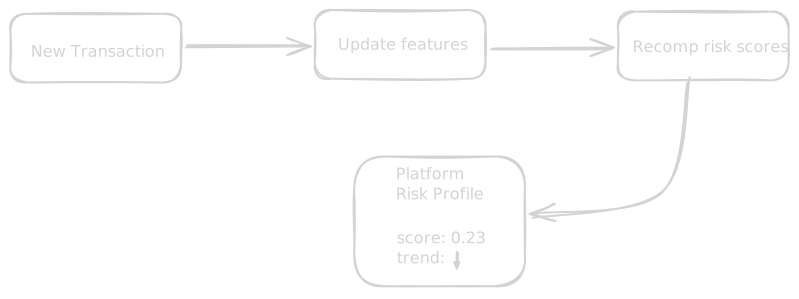
This enables dynamic adjustment. A platform that behaves normally sees its risk decrease over time. A platform that spikes payout volume sees its risk increase immediately. This prevents exploitation.
Payout decision flow
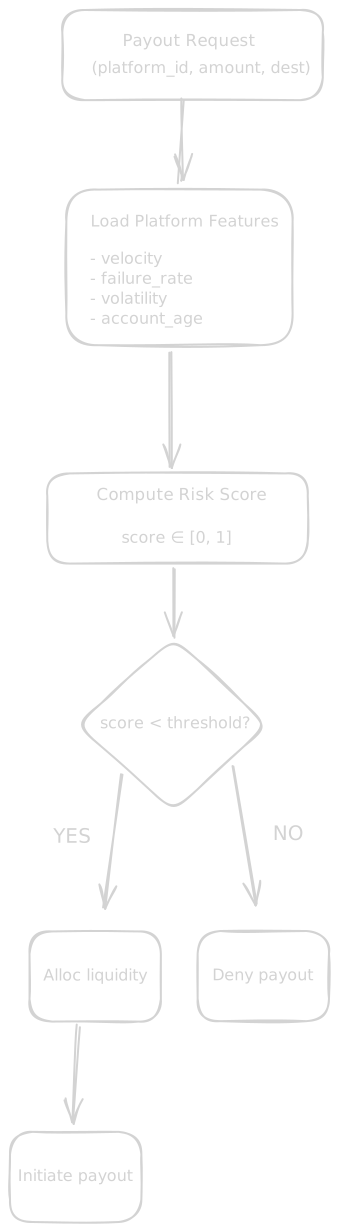
Liquidity allocation must be atomic to prevent race conditions. This is enforced using atomic reservation algorithms that lock and release liquidity in a single transaction.
Failure and adversarial scenarios
The risk engine must defend against several attack vectors. Liquidity draining attacks involve an attacker creating a platform, building fake history, then requesting a large payout. Behavioral stability features and account age requirements mitigate this. Velocity attacks involve sudden payout spikes. Financial velocity features at multiple time windows detect these immediately. Coordinated abuse involves multiple platforms draining liquidity simultaneously. Global liquidity monitoring across all platforms prevents this.
Risk scoring detects all of these patterns because the feature set is designed to make them visible.
Conclusion
This architecture transforms prefunding into probabilistic liquidity allocation. Instead of requiring capital upfront, liquidity is allocated dynamically based on risk. This enables instant payouts, efficient capital usage, scalable liquidity allocation, and safe operation without prefunding. The key insight is that liquidity allocation is fundamentally a risk problem. Correctly modeling risk makes prefunding unnecessary.
With this design, stablecoins can be paid out to creators around the globle instantly without requiring the platform to front its own USDC treasury.
Stay tuned for the next article that will go over our technical implementation for this engine!